The High Density Trap: Why More Hair Equals Worse Realism
In the commercial wig market, density percentages have become synonymous with luxury value.
Consumers believe higher numbers mean better quality: 130% is 'thin,' 150% is 'standard,' and 180% to 200% is 'premium luxury.' Factories love this because they can charge fifty to one hundred dollars extra for high-density units. They really do.
Yet it's the number-one complaint heard in salons worldwide:
'My wig looks like a bulky wig hat. It stands two inches off my forehead and makes my head look gigantic.'
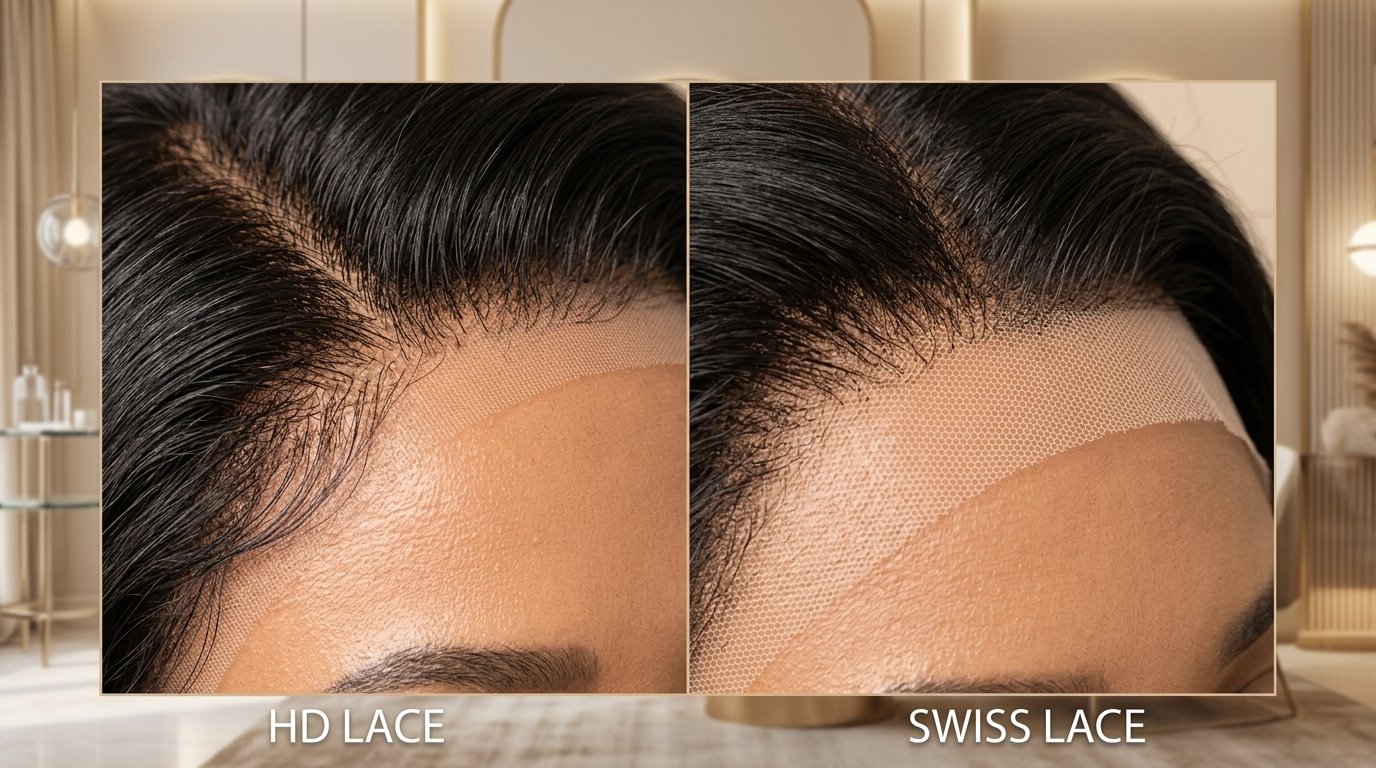
The flaw isn't the volume of hair on the back of your head. The flaw is that commercial factories pack uniform density right up to the front edge of the lace. They knot dense double-hairs right at the boundary line, creating an unnatural wall of hair that screams 'wig' from thirty feet away.
Biological Scalp Anatomy: The 60 to 140 F/cm² Follicle Curve
Look at your natural biological hairline closely in a magnifying mirror.
Does your natural hair start as a thick, solid wall of black fibers? Not at all. It's got soft, fine baby hairs at the perimeter.
Clinical trichology proves that natural scalp density follows an asymmetrical logarithmic curve across the skull:
- Zone 1: The Perimeter Transition (First 0.5cm - 1.0cm): Fine, translucent baby hairs and single-follicle units with an ultra-light density of only 60 to 80 follicular units per square centimeter (F/cm²). Light passes right through to the scalp.
- Zone 2: The Mid-Frontal Ramp (1.0cm - 3.0cm behind hairline): Follicles group into 2-hair clusters, with density gradually rising to 90 to 115 F/cm².
- Zone 3: The Crown Apex & Parietal Ridge (3.0cm+ inward): Full terminal 3-hair and 4-hair bundles emerge, reaching mature biological maximums of 130 to 150 F/cm².
Nature never creates uniform density. A real human hairline is an optical transition zone designed to diffuse incoming light.
The Blunt Ledge Effect: Why Heavy Hairlines Cast Shadows
Why do factory 180% density frontals look so glaringly obvious in daylight?
It comes down to shadow formation.
When sunlight or indoor ceiling lights hit your head from above, light needs to filter through the front hair strands to illuminate the skin underneath. In natural hair, that 70% perimeter density allows 30% of incoming light to reach the scalp, creating soft, natural depth.
When a factory knots 180% density right at the lace border, the hair forms a solid, opaque barrier.
It casts a dark, artificial shadow directly across your forehead. That's what gives it away. That heavy shadow creates a visual 'cliff' or blunt ledge that immediately outlines the wig perimeter. People don't even have to look closely—their subconscious brain notices that unnatural optical ledge instantly. It looks like a helmet visor. It really does.
The Plucking Fallacy: Why Tweezers Can't Fix Base Ventilation
Every wig tutorial on YouTube tells you the same advice: 'Just pluck the hairline with tweezers!'
So women sit in their bathrooms for two hours, painfully ripping out hairs with tweezers. But what happens?
You end up with bald patches, ripped lace holes, and broken stubble hairs.
Why? Because plucking's a destructive afterthought. If the factory tied coarse double-knots at 180% density, pulling random hairs out leaves jagged, irregular gaps while the remaining knots stay bulky and black. You can't fix fundamentally flawed factory ventilation with tweezers. True anatomical realism's got to be hand-ventilated correctly from stitch one.
The 3-Tier Density Blueprint: Transition, Mid & Apex
In our bespoke cranial workshop, we build frontals using an anatomical 3-Tier Density Blueprint:
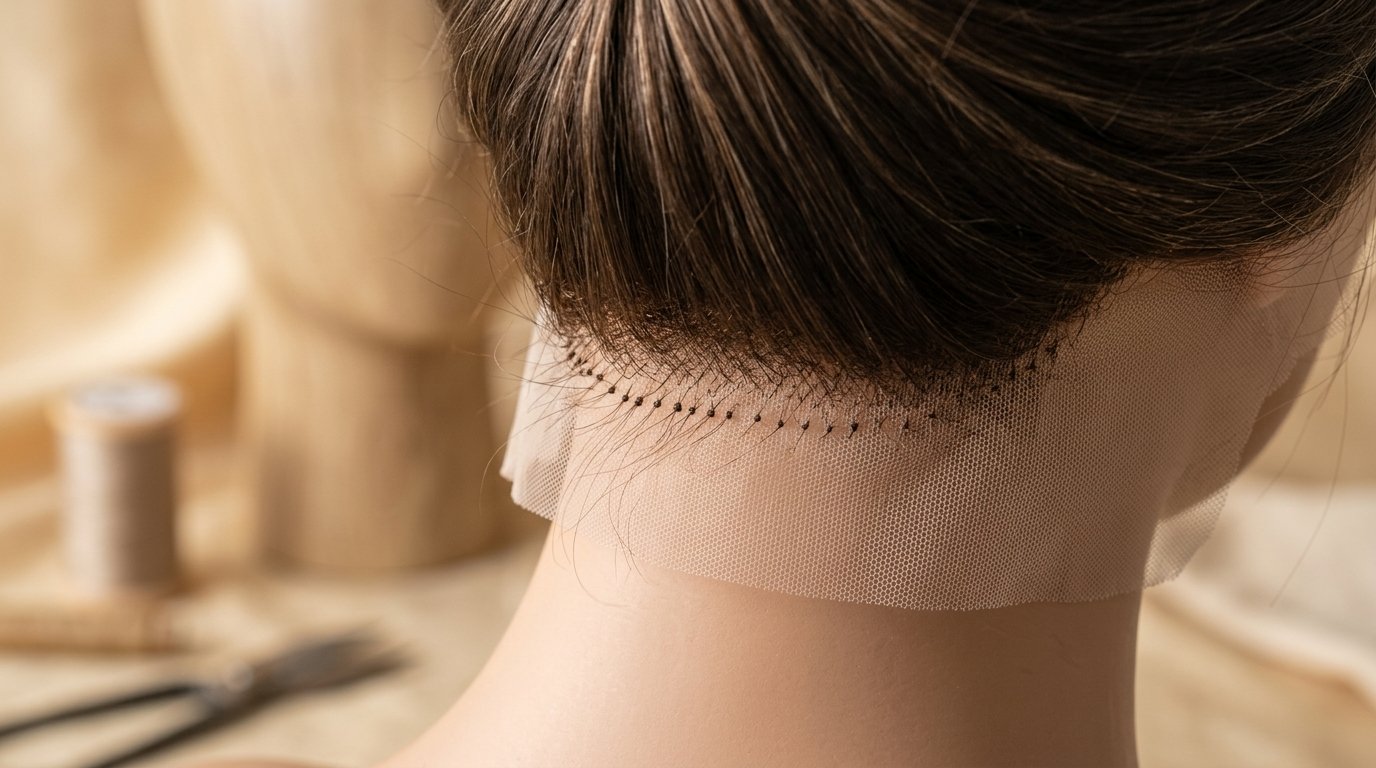
- The Feathered Perimeter (0% to 70%): Across the front three-quarters of an inch, we ventilate exclusively single hairs using microscopic split-knots spaced 1.5mm apart. It looks like natural peach fuzz growing out of living skin pores.
- The Structural Gradient (80% to 120%): Across the next two inches, density smoothly scales up from fine singles to soft doubles, providing natural coverage without creating a heavy ridge.
- The Volumetric Core (130% to 150%): Only once we reach the crown, apex, and rear wefts do we introduce full volume. That gives you thick, luxurious, bouncy body through the lengths while keeping the hairline whisper-soft and completely flat. You'll love the movement.
Cervical Weight Balance: Eliminating Headaches & Drag
There's another critical reason to avoid uniform 180% density: cervical neck fatigue.
A 180% density wig packed with hair from front to back weighs over 300 grams. That excessive frontal mass pulls the wig forward and downward against your forehead, forcing you to tighten the nape straps painfully so the unit won't slip.
By using anatomical density mapping, our custom wigs deliver the exact same visual fullness through the lengths while cutting total finished weight down to 120 to 145 grams.
Zero forehead drag. Zero tension headaches. Zero bulky helmet silhouettes. It's night and day.
The Silky Fusion Standard: Bespoke Gradient Crafting
At Silky Fusion, we don't believe in one-size-fits-all factory wigs. We really don't.
Every single closure, frontal, and custom wig we build's hand-ventilated strand by individual strand following your personal head contours. We'll map the density gradient to match your biological face shape, forehead curve, and natural baby hairs.
When you put on a Silky Fusion piece, it doesn't stand up like a helmet. It lays completely flat, flows with effortless natural bounce, and melts seamlessly into your forehead in any lighting condition. You'll feel completely confident.
That's what true master trichology looks like. Fullness where you want it. Invisibility where you need it.