What Hair Porosity Really Means: Physics, Not a Grade
Spend five minutes on social media and you'll see people talking about hair porosity like it's a school report card. Someone posts a tearful video claiming high porosity ruined their life. The next creator brags that low porosity hair is the only true mark of virgin quality.
Honestly? That's complete nonsense.
Porosity isn't a scorecard. It's just physics.
At its core, porosity tells you how fast water moves into your hair and how quickly it evaporates. That's it. Everything comes down to your cuticle scales. When scales lie flat and tight, water struggles to get in. But when chemical bleach or flat irons blow those scales wide open, moisture rushes straight inside without any natural barrier to stop it—and then it vanishes ten minutes later into thin air, leaving your hair feeling like stiff sandpaper.
We see this in our workshop every single week.
A stylist washes two client pieces with the exact same salon-grade argan mask. On one unit, the oil sinks in within thirty seconds, leaving the strands supple and glossy. On the second unit, the identical mask sits on top like a greasy wax layer, leaving the core feeling like dry straw. Why? Because the cuticle architecture is behaving in completely different ways. If you treat them with the exact same routine, one will turn into a tangled disaster. You don't want that.
The Laboratory Reality: Sorption Rates
In hair labs, scientists test porosity by weighing individual strands before and after humidity exposure. Healthy, compact hair absorbs about 30% to 35% of its dry weight in water before it's saturated. Chemically blasted hair can take in up to 45% or more, yet it bleeds that moisture right back into the dry air twice as fast. It holds water like an open sieve.
Cuticle Anatomy: Your Hair's Shingled Armor
To wrap your head around porosity, look at the outer wall of the hair shaft. Hair isn't a smooth plastic wire. It's covered in six to ten overlapping layers of keratin cells. Think of shingles on a steep roof or scales on a pinecone.
Each scale is razor-thin—under a single micron thick. But each one has distinct biological layers that dictate how water behaves:
- The Epicuticle: The outermost invisible skin, coated in a specialized natural lipid called 18-MEA. This lipid layer is what gives untreated virgin hair its hydrophobic slip. It makes water bead up on contact instead of soaking straight in.
- The Exocuticle: Sitting right beneath that lipid film, this layer makes up over half the scale's mass. It's packed with sulfur-rich cystine bonds, making it tough, rigid, and resistant to rough combing.
- The Endocuticle: The softer belly of the scale. It contains very little sulfur. When water gets past the upper layers, the endocuticle swells like a sponge, pushing the outer scales upward.
- The Cell Membrane Complex (CMC): The biological glue holding adjacent cuticle scales together. Composed of ceramides and fatty acids, this is the narrow highway water travels down to reach the cortex.
When those shingle layers stay flush and unbroken, water has to work hard to seep through the tiny lipid cracks. That's low porosity. But strip that 18-MEA lipid layer away with high-pH bleach, or chip the scale edges with daily 450°F flat irons, and you leave the front door wide open. Welcome to high porosity.
Low Porosity: Tightly Packed Scales & Water Resistance
Low-porosity hair has cuticle shingles that lie completely flat against the strand. You see this most often in raw temple hair, untreated virgin bundles, and hair that's never been bleached or permed.
What You Notice Right Away
Low-porosity hair has unmistakable habits:
- Natural Mirror Shine: Because the outer surface is smooth and flat, light bounces straight back off it. You get a glass-like sheen without having to dump half a bottle of shine spray on your head.
- The Beading Effect: Mist a fine spray of water onto dry hair. Instead of vanishing into the strand, the droplets sit on top in tight little pearls for a full minute.
- Long Wetting Times: You have to hold it under running warm water for several minutes before it's actually soaked to the bone.
- Product Buildup Nightmares: Thick butters and heavy oils can't slip past those tightly clamped scales. They just coat the outside. Within three days, your hair feels gummy, limp, and collects every piece of dust in the room.
Here's the trap. People think low-porosity hair is indestructible, so they neglect deep conditioning. But if you slap cold conditioner onto low-porosity hair, the ingredients never penetrate. The core stays thirsty, and the outside gets heavy and greasy. You have to use mild warmth to convince those scales to open up.
High Porosity: Sponge Absorption & Flash-Drying
At the other extreme, you have high porosity. Here, the cuticle shingles are flared, cracked, or completely missing in spots. The internal cortex is exposed to whatever shampoo, humidity, or chlorine happens to be nearby.
Some people have naturally high porosity hair due to tight curls that lift at natural bends. But in the hair extensions world, high porosity almost always comes from chemical torture: high-lift bleach, acid baths, or aggressive heat.
The Danger of Hygral Fatigue
High-porosity hair absorbs water instantly. The second you step into the shower, it's soaking wet. But here's the catch: it can't hold onto that water for dear life.
Within fifteen minutes of stepping out of the shower, moisture evaporates into thin air. Trichologists call this flash-drying. One minute your hair is wet, and twenty minutes later it's crunchy, stiff, and rough to the touch.
This rapid swing between swelling and shrinking causes hygral fatigue. Every time water rushes inside, the hair strand swells outward by up to 16% in diameter. When it dries, it contracts back down. Doing that cycle two or three times a week without lipid protection creates microscopic stress fractures inside the strand. Eventually, the hair snaps in half under light brushing.
Watch Out for the Sponge Trap
If your bundles soak up water in two seconds flat, but turn into dry straw before you even finish blow-drying, your cuticles are heavily compromised. Piling on raw protein treatments in this state won't fix it—it will make the strands even more brittle and prone to breakage.
What Alters Cuticles: Bleach, Flat Irons & Acid Baths
Porosity isn't fixed forever. A 20-inch strand of hair might have low porosity at the roots, medium porosity at the shoulder, and severe high porosity at the tips. Why? Because hair gets beaten up as it ages.
1. Bleach and Ammonia
Lighteners work at a high alkaline pH—usually between 9.0 and 11.5. That high alkalinity forces the cuticle scales to flare wide open so oxygen radicals can dive in and destroy melanin pigments. Even after you rinse with acidic shampoo, those scales never close back down completely flat. They stay slightly raised.
2. High-Heat Styling Tools
Flat irons running at 400°F (204°C) boil any trapped moisture inside the hair shaft. That steam expands violently and blasts microscopic holes right through the cuticle walls. Trichologists call this bubble hair. Once a crater blows out, it's permanent.
3. Sunlight and UV Exposure
Daily sun oxidizes natural cystine bonds into cysteic acid, stripping away the outer 18-MEA lipid layer and leaving the hair rough and porous.
4. Industrial Factory Acid Baths
Cheap commercial factories collect fallen floor hair from salons and drains. Because the roots and tips are scrambled, the cuticles would knot instantly. So factories dunk the hair in hydrochloric acid to burn all the scales clean off. Then they coat the bare strands in silicone to fake a healthy shine. After five washes, that silicone washes off, leaving behind a wrecked, high-porosity core that shreds in your hands.
| Porosity Level | Cuticle Condition | Wetting Speed | Moisture Hold | What It Actually Needs |
|---|---|---|---|---|
| Low Porosity | Flat, tight scales with intact 18-MEA lipids | Slow (takes 1–2 minutes under steady warm water) | Excellent once water gets inside | Warm water rinses, light humectants, aloe, clarifying washes every 3 weeks |
| Medium Porosity | Slightly flexible scales, normal everyday wear | Normal (takes 20–30 seconds to soak) | Balanced absorption and steady drying | Mild hydrating conditioners, argan oil drops, occasional protein balance |
| High Porosity | Lifted, chipped, or missing scales; bare cortex | Instant (soaks up water in 3 seconds flat) | Terrible; flash-dries into stiff straw | Acidic rinses (pH 4.0), hydrolyzed silk peptides, ceramides, rich sealing oils |
Matching Products to Porosity: Oils, Proteins & Humectants
Stop buying hair products just because an influencer swore by them. If their hair porosity is high and yours is low, their holy grail conditioner will turn your hair into a greasy, weighed-down disaster.
Rules for Low-Porosity Hair
Your goal is simple: get moisture past tight scales without leaving a waxy coating on top.
- Ditch heavy butters: Raw shea butter and thick mineral oils can't slip between flat cuticle shingles. They just build up on top and attract lint.
- Use lightweight humectants: Look for glycerin, sodium PCA, and aloe vera. They draw moisture in without suffocating the strand.
- Use gentle warmth: When you apply a hair mask, wrap your hair in a warm damp towel. The heat loosens the scales just enough for ingredients to enter.
- Clarify regularly: Wash with a residue-free clarifying shampoo once a month to strip away stubborn product film.
Rules for High-Porosity Hair
Here, your goal is the exact opposite: patch the holes and trap moisture inside before it evaporates.
- Hydrolyzed proteins: Small protein molecules like hydrolyzed silk or wheat peptides slip into damaged cracks and temporarily stiffen the fiber.
- Ceramides: Think of ceramides as mortar between loose bricks. They help glue frayed cuticle remnants back down.
- Acidic sealing: Always finish wash day with a pH-balanced conditioner (around pH 4.0). Mild acidity forces raised cuticle scales to contract.
- Sealing oils: Once hair is damp and conditioned, smooth a couple of drops of argan, jojoba, or avocado oil over the ends to slow down moisture loss.
Drying Dynamics: Why Bundle Hair Dries Differently
Drying time tells you almost everything you need to know about your hair's surface health.
Have you ever noticed something strange about high-porosity hair? When left hanging in a thick bundle or wig cap, it seems to take forever to dry. Yet if you pull out a single strand, it flash-dries in five minutes. Why?
It's all about surface tension and capillary action. In a thick bundle, lifted cuticles snag against each other, trapping huge volumes of water inside the mass like a wet sponge. Restricted airflow keeps the core damp for hours. But the moment individual strands are exposed to moving air, the lack of an intact lipid roof lets free water evaporate in a flash, leaving behind brittle, static-filled hair.
Low-porosity hair behaves the exact opposite way. Water penetrates slowly, binds evenly with internal proteins, and dries at a steady, predictable pace from root to tip.
Hair Systems vs Natural Hair: The Missing Sebum Problem
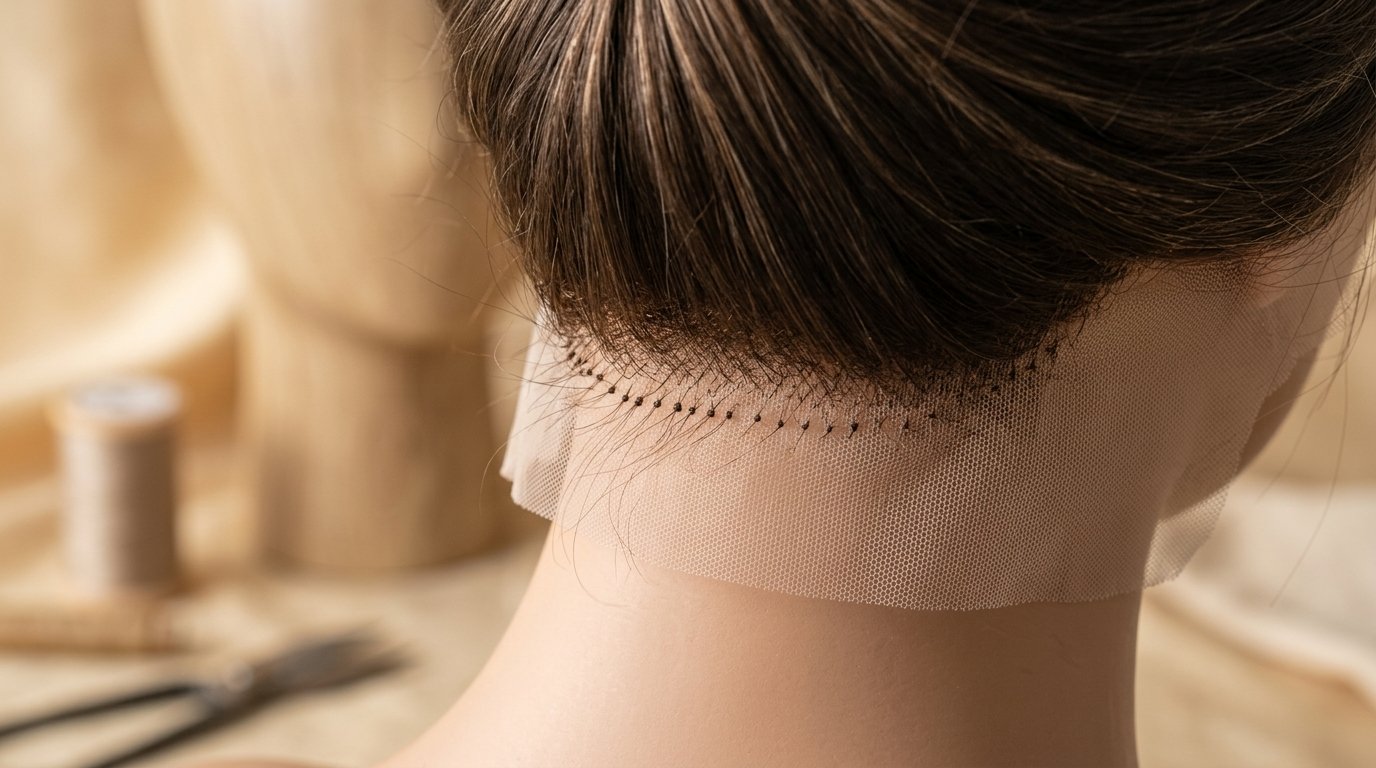
If you wear a custom hair system, wig, or lace frontal, listen closely. Hair systems play by completely different rules than the hair growing out of your scalp.
Why? Because a hair system has no sebaceous glands.
On your head, your scalp pumps out natural sebum every single day. That sebum slowly travels down the hair shaft, coating cuticle scales in a protective lipid shield. A wig never gets that free refill. Every time you shampoo a wig, you strip away lipids that will never come back naturally.
Over time, even the most pristine raw temple hair will drift toward higher porosity simply from friction against clothes, pillowcases, and hot water washes. That's why wig wearers must artificially replenish those lost lipids with high-purity leave-in serums and keep wash frequencies under control.
The Silky Fusion Routine: Real-World Wash & Seal Habits
At Silky Fusion, we only work with authentic, single-donor raw temple hair. Our hair still has its native 18-MEA lipid layer intact, meaning it starts with naturally balanced, low-to-medium porosity. Here's how we advise clients to keep it that way for three to five years:
- Lukewarm Water Only: Never scald your hair systems under boiling hot shower water. Scalding heat expands cuticle shingles and strips delicate lipids.
- Sulfate-Free Cleansers: Harsh sulfates blow cuticle scales wide open. Use a gentle, sulfate-free cleanser with a pH between 5.0 and 5.5.
- Always Condition in One Direction: When applying conditioner, smooth it downward from roots to tips. Never bunch or scrub the hair in a circular motion, which forces cuticles to grind against each other.
- Cold Acidic Finish: Rinse your conditioner with cool water, or use an apple cider vinegar rinse diluted to pH 4.0. That gentle acidity locks the cuticles tight.
- Pat, Don't Rub: Never wring out your hair with a rough terry-cloth bath towel. Wrap it in a 100% cotton tee or a microfiber wrap, and gently press the water out.
Treat your cuticles like fine silk. Once you protect the armor, the hair takes care of itself.